Business strategy
Reading a business to find where value actually gets created and where it quietly leaks out, then making the case for change to the people who control the budget. Ideas do not move without a number attached.
I have built a career out of noticing the gap between how work gets done and how it could be done, and then being the person who steps in to close it. Lately that splits two ways.
I train corporate teams to put AI to work on the problems already on their desks.
Explore Corporate AI TrainingWhen I am not training, I build games, tools, agent infrastructure, and audio, because building things is how I come to understand them.
Browse Creative ProjectsThese look like four different careers on paper, and in practice they have all been the same move: find the thing nobody has claimed yet, understand it properly, and then do it. Every role below started as work that was not in anyone's job description.
Reading a business to find where value actually gets created and where it quietly leaks out, then making the case for change to the people who control the budget. Ideas do not move without a number attached.
Built an AI enablement program from scratch inside a global electronics manufacturer, serving five operational functions. Non-technical teams went from curious about AI to pitching their own use cases to the people who fund them.
Supported an international engineering team as they stood up a state-of-the-art AI and data runtime and harness platform inside a global applied-AI office, coordinating across time zones, languages, and very different levels of technical maturity. Also led training delivery.
Operational readiness and service delivery at real scale, with real throughput and turnaround targets. This is where I learned that people and process decide whether a change sticks.
These are the numbers I can stand behind. The teams did the work. My job was to give them a method, get the room safe enough to use it, and stay long enough to see it land.
Specific AI use cases surfaced across departments and business functions.
Person offshore operations workforce trained, driving a 200%+ turnaround-time improvement.
Operational functions enabled: HR, finance, legal and government affairs, supply chain, and marketing.
Years designing and delivering training in complex service-delivery environments.
Most of the difficulty lives in the stretch between finishing a course and shipping something that delivers value, so everything I do is built around getting teams across it. The shape is deliberately repeatable, so it works for one team or for twenty.
Before any workshop I learn where the team actually is. Surveys and light pre-work surface the real pain points, and every deck gets rewritten in the group's own language before anyone sees it.
Hands-on rather than lecture. Teams work their own use cases the whole way through, and at the end they pitch them to their own sponsors, the way you would pitch an investor.
After the workshop I track each use case toward development, run office hours to keep people unblocked, and recruit champions inside the team to carry it.
Turn a vague frustration into a concrete problem worth solving.
Design how AI fits the real workflow, with a human in the loop where it counts.
Decide what to build, what to buy, and how fast you can get to something working.
Put numbers on it. This is the step that turns a good idea into a funded one.
Put it in front of real users and learn what the slides could not tell you.
Instrument the result so the impact is provable and the next move is obvious.
Three participants from three unrelated functions, who never worked together, each took a different problem through the six steps. They arrived at the same design: a fixed template, a trusted source to ground it, a hard check the model cannot talk its way past, and a named person accountable for the output.
None of them asked for a platform. Each asked their sponsor for a two-week test, with the go/no-go thresholds and the conditions for stopping written down before it started. One of them concluded that nothing needed to be built at all, and that the review step was the actual product.

Adoption happens when people feel safe enough to admit what they do not know. These are from participants in recent enablement workshops.
"Kevin created an atmosphere of psychological safety, enabling many valuable cross-functional conversations during our recent workshop."
"The facilitator explained concepts well. I appreciated when he slowed down at times to make sure nobody in the room was left behind."
"This workshop was time well-spent. It opened my eyes to new ways of using AI."
I came to this work through adult learning rather than engineering, which turns out to be the useful direction to come from. I hold a BA in Communications, I have worked in Japan and the Philippines, and I live in Vancouver, Washington.
The other thing worth knowing is that I build constantly. It is how I learn a tool properly, and it is where most of what I teach came from originally.
I automate the boring parts of a job so that capable people can spend their time on the work that actually needs them.
Stay curious: build the thing you are wondering about, and see what happens. That is the whole practice. This is the running list of what has come out of it. Several of these turned into things I now teach professionally, which was not the plan. Filter by what you are looking for, or just scroll.

A personal agent orchestrator with a persistent context brain, subagent workflows, a tracked portfolio with value and complexity scoring, and a dashboard to see the whole thing at once. My favorite part is the least glamorous: a budget guard that stops a run before it overspends, and a verifier agent that grades the work before anything reaches me.
It is the most honest answer I can give to "do you actually use this stuff." I have been living inside it for a year.
Several small games, some finished and published, some still only a good title and a bad idea. They live together under a studio name so they stop cluttering my desktop.
A pipeline I built to turn a one-line idea into a finished browser game: design, build, polish, test, and ship. Cheaper models handle the mechanical stages, better ones are reserved for the judgment calls.
The version of Foundry built to run the whole pipeline across many games in one batch instead of one at a time, useful when I want to compare several ideas before committing to any of them.
A fantasy home run derby that runs on a Google Sheet and the MLB stats feed, and a fantasy football assistant that writes my league a personalized newsletter every week. Sometimes the right tool is the one already open.
Tracing my family from a farm in Pudasjärvi parish to a dairy farm in Eden Valley, Washington, working from communion book scans and a lot of guessing at handwriting. The goal is a written narrative my family can actually read.

A skill that drafts chapter prose from an outline, for a novel I am currently writing. It does not replace editing. It gets a rough chapter onto the page fast enough that editing is where I actually spend my time.
Favorite model, Opus 5. I have now used roughly 161 times more tokens than there are in The Great Gatsby.
Public repos and commit history, kept current by GitHub itself, not by me remembering to update a screenshot.
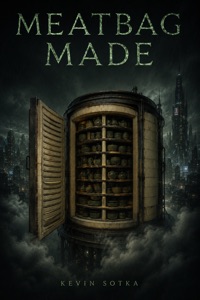
From writing blogs and novels to building mental health awareness communities to producing original music, art, games, and other products and content, Meatbag Made is where my wife and I keep our creative portfolio.
You do not need a project, a budget, or a reason. If something about the way your team works is slow, expensive, repetitive, or just strange, tell me about it and I will give you a straight answer about where I would look first.
No form, no sequence, no funnel. The message goes to my inbox and I answer it myself, usually within a day or two.